
Why Voice User Interfaces Matter for Modern Website Design
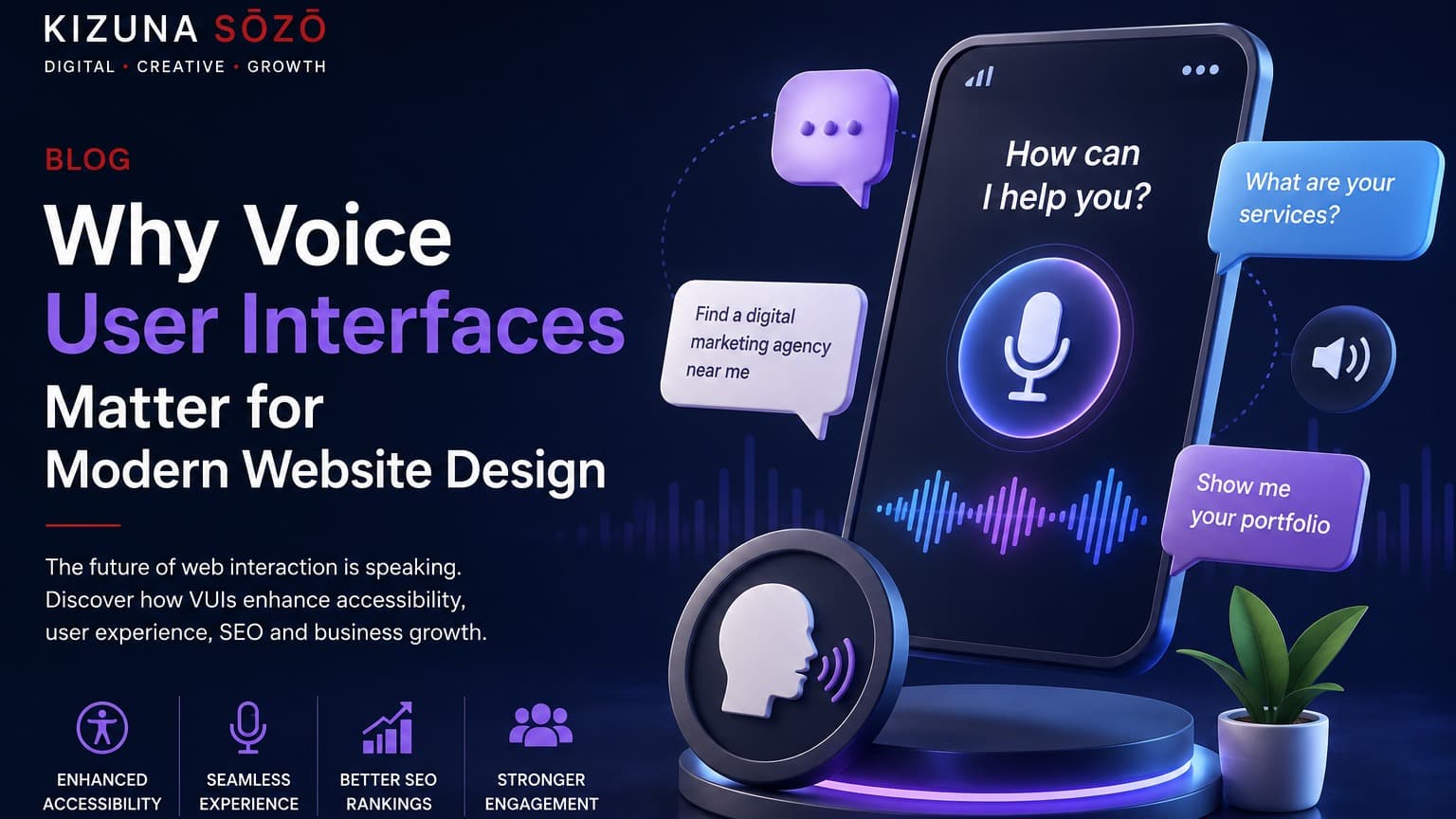
The way people interact with websites is changing. Users are increasingly comfortable speaking to smartphones, smart assistants, and connected devices to search for information, find businesses, complete simple tasks, and get quick answers. This shift creates an important opportunity for brands: websites can no longer be designed only around clicks, screens, and menus.
Voice User Interfaces (VUIs) introduce a more natural way for people to interact with digital experiences. When thoughtfully integrated with website strategy, UX, content, and technical architecture, voice can make a digital platform more accessible, faster to navigate, and more aligned with how modern users search and communicate.
1. Making Digital Experiences More Accessible
Accessibility is one of the strongest reasons to consider voice interaction in website design.
Typing, scrolling, and navigating small mobile interfaces can be difficult for some users, including
people with visual, motor, or other accessibility needs.
Voice-based interaction can reduce these barriers by allowing users to communicate through natural
spoken commands. For brands, this means designing digital experiences that are easier for a wider
range of people to use.
At Kizuna Sōzō, we approach accessibility as part of the overall user experience rather than as
an afterthought. The objective is to make a website feel simple, intuitive, and useful.
2. Adapting to Conversational Search
People do not always speak the way they type. A typed search may contain only a few keywords,
while a spoken query is usually longer, more conversational, and closer to a complete question.
For example, a user may type “digital marketing agency Lucknow” but ask, “Which digital marketing
agency can help my business grow in Lucknow?”
This change in search behaviour makes conversational content, clear information architecture,
well-structured pages, and useful answers increasingly important. Website strategy should therefore
consider not only what users click, but also what they may ask.
3. Creating Better Mobile Experiences
Mobile users often interact with websites while travelling, commuting, shopping, or multitasking.
Voice interaction can reduce dependence on repeated tapping, typing, and scrolling.
For example, instead of navigating through multiple pages to find contact information, a user could
use a voice-enabled experience to reach the relevant information more directly.
Good mobile UX is ultimately about reducing friction. Voice can become another interaction layer
that complements strong visual design rather than replacing it.
4. Shortening the Customer Journey
A well-designed website should help visitors reach their intended information quickly. Complex
menus, excessive steps, and unclear navigation can create unnecessary friction and increase the
chance that a visitor leaves.
Voice interfaces can simplify certain journeys by allowing users to ask for information directly.
This can be particularly useful for FAQs, product discovery, service information, location details,
booking flows, and other repetitive website interactions.
At Kizuna Sōzō, we focus on designing customer journeys around the user's objective first and the
technology second.
5. Creating More Human Brand Interactions
Voice is inherently conversational. When a digital experience responds in a clear and purposeful
way, the interaction can feel more direct and human than a purely menu-driven interface.
Brands can also define the tone, language, and personality of their voice interactions so that they
remain consistent with the wider brand identity.
This is where branding, UX writing, interface design, and technology come together. A voice experience
should not feel like an unrelated feature; it should feel like a natural extension of the brand.
6. Preparing Websites for the Future
Digital behaviour continues to evolve. New devices, AI-powered assistants, conversational search,
and multimodal interfaces are changing how people discover and consume information.
Brands that plan their website architecture with flexibility in mind can adapt more easily as these
technologies mature. This does not mean every business needs a voice interface immediately. It means
the digital foundation should be designed so that new interaction models can be introduced without
rebuilding everything from scratch.
Future-ready design is about making smart technical and UX decisions today that leave room for
tomorrow.
7. Supporting Local and Intent-Based Search
Voice searches often express a clear intent. Users may ask for nearby services, opening hours,
directions, contact details, recommendations, or answers to specific questions.
For local businesses, this makes clear business information, strong website structure, useful
content, and local SEO particularly important. A website should make it easy for search engines and
users to understand who the business is, what it offers, where it operates, and how it can be contacted.
Voice optimisation should therefore be treated as part of a broader digital and search strategy.
8. Standing Out in a Competitive Market
Many websites still rely on conventional navigation and static information. A carefully implemented
voice feature can help a brand offer a more distinctive digital experience.
However, innovation alone is not enough. The feature must solve a genuine user problem, work reliably,
and fit naturally into the overall website.
The strongest digital experiences combine visual identity, UX, performance, content, and technology.
That is the approach Kizuna Sōzō takes when building digital platforms for modern brands.
Conclusion
Voice User Interfaces are becoming an important part of the broader conversation around modern website design. They can improve accessibility, support conversational search, simplify selected customer journeys, and create more interactive digital experiences.
The right approach is not to add voice technology simply because it is trending. Businesses should first understand their audience, identify meaningful use cases, and then connect voice interaction with a strong UX, content, SEO, branding, and technical foundation.
Kizuna Sōzō helps brands build digital experiences that combine strategy, creative design, technology, and performance. Whether you need a new website, a UX/UI experience, digital marketing, performance marketing, or a stronger online presence, our focus is on creating digital work that serves a clear business purpose.
FAQs
1. What is a Voice User Interface?
A Voice User Interface (VUI) allows users to interact with a digital product or service using spoken commands instead of relying only on typing, clicking, or touch.
2. Does voice interaction affect website SEO?
Voice itself is not a replacement for SEO. However, conversational search behaviour makes clear content, useful answers, strong information architecture, and search-friendly website structure increasingly valuable.
3. Is voice navigation useful for every website?
Not necessarily. Its value depends on the audience, business model, user journeys, and use cases. Voice should be introduced where it provides a meaningful improvement to the user experience.
4. How can voice technology improve accessibility?
Voice can reduce the need for physical typing and complex touch interactions, potentially making selected digital tasks easier for users with certain visual or motor limitations.
5. Can voice features be added to an existing website?
In many cases, yes. The approach depends on the website's technology, architecture, desired functionality, and the specific voice use case. A technical and UX assessment should be completed before implementation.